Products
Chanel Consumer App
Chanel Shop Floor App
Connected Mirror
My Role
Design Team Lead
Team
5 Designers in London
10+ Dev Team Lisbon
Introducing the Store of the Future
The Store of the Future concept centred around one question. How can we better connect brands and customers through technology to elevate their shopping experience? The store should respond to the user intuitively not so that they walk around the store with their head down, but up, with the store adapting around them to show the right product at the right time in the most elegant way possible.


Chanel
Incredibly interested in spearheading the elevation of the shopping experience through technology and engaging with a new generation of brand advocates, Chanel saw the SoF concept as their opportunity to do this. They felt that this technology could enrich the experience of the in-store customer. It could be used as a mechanism to stimulate two way conversations between fashion advisors and their clients.
The project had experienced a bumpy start. I was brought on after it had kicked off and with it the project found somewhat of a reset moment. I was afforded the opportunity to assemble a team of designers that could rise to the challenge Chanel had set.
Our team was asked to combine technology with design thinking and experience design in order to create stronger brand advocacy, deliver a more tailored, personalized and luxurious experience, but also to maintain the human element that is at the heart of every interaction between a fashion advisor and their clients. No pressure then.


Understand your audience
This project had already been going for a little while before I joined it. With that in mind there were a few things I immediately set about understanding. The design team working within the London office had not had any face time with the client at all. I felt this was one of the key issues that had led to where we found ourselves, so this immediately had to change.
Goal number one was to understand more about Chanel as a brand and their intended target audience. This was done very simply by setting up meetings with our points of contact Geraldine and Sophie from Chanel in order for the team to ask questions. Chanel as an organisation is very hierarchical, so if there were questions that could not be answered in this session, they would be noted, asked to other stakeholders, and we would find out the answer later. It was established that their primary focus for this experience was what they called VICs (very important customers). These customers would be taken to the private fitting rooms upstairs in the store away from the rest of the clients and would spend upwards of €200,000 in a single sitting.
It had already been determined that this experience would be trialled with these VIC clients first as the experience would be easier to control and allow for the fashion advisor to step in if for whatever reason the technology was not working as expected.


What did we do?
With this narrative in mind we mapped out two key journeys. I wanted to understand what the current journey for a customer looks like when they are going to arrive at a store and go through the as-is process. We analysed this journey, we identified the points at which we felt there were opportunities to intersect and introduce technology that could aid and add value to it without disruption. We then compared this to the one we had mapped at Browns East with the Store of the Future technology in place. This included all the moments of interaction between the physical actors, the space and the technological pieces.
Fundamentally from this exercise I wanted to understand what Chanel perceived would be the ideal outcome. In a nutshell, what success looked like for their customers, and for them as a business as well as how we might measure that. All the while, augmenting it with key learnings and successes from Browns.


Cleaning House
Another challenge that had presented itself with this project was the fact that as a platform and product company, we were maintaining two other Shop Floor Apps for Browns and Thom Browne, and a Mirror App for Browns as part of the day to day. Unfortunately for one reason or another, the libraries of these apps had become cross contaminated. Components from one app that were inconsistent with designs from the other had found their ways into each other's libraries. This had also become worse with the fact we were creating a new Shop Floor App for Chanel. Add to this the Consumer App in development and it was clear, we needed to get our house in order.


We needed a plan
All in we had a team of 6 designers including myself. I assessed the strengths of the team and we made a plan together. Of the designers on the team, three were stronger visual designers, one was a junior with more of a UX lean, one was a very senior UX designer and there was myself who has a strong background in both visual and UX. This worked perfectly as we could divide the work into buckets. Monica and Sandy (Senior UX and junior) could audit the experience and identify the inconsistencies with myself as a sense check, while Antonio and Courtney could clean up the visual components, library and style guide. Steve on the other hand could continue to work on the Consumer App where Chanel’s attentions were immediately focused, so any pause in work for us to clean up the other apps, would be imperceptible to the client. I would be responsible for the review of all works and continue with client facing meetings and discussions.
I communicated to the Product Owners and Management that we needed a period of one 2 week sprint to get our house in order across the apps. That we must for the longer term sake of the project, come to a brief pause, in order to allow more rapid movement forward in the long run. Thankfully they agreed and we set to work engaging with our colleagues in engineering to ensure that we were able to give them clear functional specs and make sure that they were clear on the differences between the apps.
Consumer App & Mirror
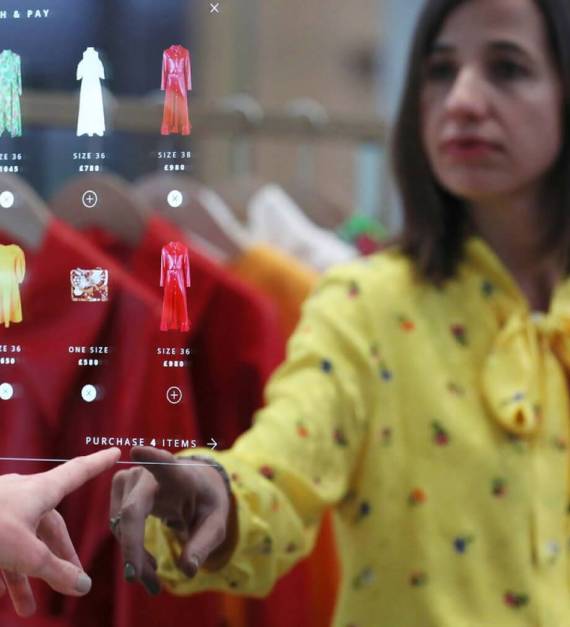
The major differences between the experience for Browns, Thom Browne and Chanel came in the form of the Consumer App and Mirror. Chanel felt the Connected Mirror needed to be more paired back and have less complex functionality than the mirror in Browns. Adding items to a basket was deemed unnecessary and took away from the theatre of the experience and the fashion advisors ability to conduct it.
The Consumer App which would be the portal to this new experience for the customer was negotiated with Apple in order to allow for an app that could live on their App Store but yet would only be available to those who had been invited. The Consumer App would allow the customer to add items to their wishlist from the Chanel catalogue, which Fashion Advisors could see and likewise add items to so that when the customer came to the store they could prepare fitting rooms with these garments.


A New Approach
A new approach to presenting designs was undertaken. In previous discussions designs had been made and presented to the team at Chanel in the form of images inserted into presentations that were given by Project Managers. We felt this was the wrong approach, it didn’t allow for full context, understanding of decision making, or the ability to see designs in a flow. Working with the management team and the team at Chanel we agreed that design would now have the lead on presenting their designs. This would allow for questions to be raised by the client and answered by the designer who put them together. Designers would put together journey maps and flows that would provide an overview of the users journeys, this would be supplemented with a presentation deck that included key screens identified and a full description and spec of intended functionality. Finally the presentation would include a link to a prototype that could be commented on, all this adding up to a vastly more collaborative and improved workflow.
Challenges
Every project comes with its challenges and this one was no exception.
The biggest challenge as a design team we found was the lack of ability to test our designs. This was because we would not be provided with access to Chanel’s customers or clients. We did ask, but unfortunately it was simply not possible. Without this we were unable to validate our hypotheses, understand the mindset of our users, or understand if there were better opportunities we should be exploring. Due to the sensitive nature of the project we could not guerilla test it either, or any other workaround hack we would normally. We had to trust entirely on our client to provide the guidance on what their customer wanted. The closest thing we could do was to test the designs we had with the in house Private Client team who support our own private clients in the purchasing of items.
In addition to this we learned that we would not be able to gain any insights from the client in the form of analytics or performance data. This was going to be an uphill struggle.
Another major challenge we faced was a stringent set of requirements that we had been tasked with for this project. Looking at the project through more of a design and experience led lens, the design team intuitively knew that there were gaps that could provide real value and delight to the customer. At every opportunity we collectively voiced these concerns and even mocked up designs that included some of these features we could in order to try and demonstrate the benefit to our internal stakeholders. Unfortunately the requirements being what they were and our engineering team already stretched, there simply was not the scope or time to change.
This leads to the fact that we were under a serious time pressure to deliver the fully working experience in a period of six months. Given the foundations we had to work with from the pre-existing apps, this was less of a challenge for the design team as we could respond rapidly to the requirements and create new designs and prototypes. However it placed our colleagues in engineering under major pressure to deliver a ground up build in not very much time at all.
Delightful Moments
Whilst we were constrained with what we could feasibly achieve in a strict timeline. It did not stop us as a team to try and deliver on delightful moments and provide a vision for the future as to what the direction of the experience could be. We brainstormed potential ideas, some good, some utterly terrible but we never stopped trying to push for a vision of the apps and experience that would provide real delight to customers and value to Chanel as a business.


Workshops & Pilot Scope
Following the successful launch of the Chanel Connected Experience. Attention turned to the next phase of the project. Within the Pilot Scope stage there would be improvements made to any pieces that were not functioning as intended and also to add in pieces that may have been descoped during the initial build.
In parallel with this activity the next wave of requirements had been gathered and put together by Business Analysts and the team at Chanel. This immediately started alarm bells ringing as this approach was a direct contributor to how we found ourselves in the position we were when I was brought on board. The team requested that we have the opportunity to run workshops with Chanel in order to understand their requirements in more detail, to map them to the current experience we have, better understand opportunities and evaluate whether the items on the list were actually adding value or were the right problems to solve.
Over the next few weeks we worked together to group and develop briefs for each of the requirements and we began to map these to the key moments that we identified in the experience. This exercise enabled us to identify questions that we would like to ask the client about things that were unclear, the validity of that requirement or present another idea or thought as to what might be worthwhile whilst still at this very early stage.


After the sessions
We ran the workshops across a period of four weeks and they seemed to have gone exceptionally well. It seemed like we were really engaging with the client and likewise them with us and adopting this more collaborative approach. However over a short period of time it became clear that whilst the workshops had gone well and some really great opportunities had come out of the discussions, Chanel had taken the decision to push ahead with the more arbitrary requirement list identified earlier. This led ultimately to the disbanding of our team one by one as the designers felt that they had no real power or ability to influence the experience and create something positive for the customer. As of May 2019, I have since moved into the Back Office tools team to work within the Pricing cluster and another new client, Harrods.

